PROJECT: EU Horizon 2020 Teaming Phase 2 project: "Baltic Biomaterials Centre of excellence - BBCE" grant agreement No. 857287.
ANNOUNCEMENT:
The BBCE project, funded by the European Commission under the Horizon 2020 programme (WIDESPREAD-01-2018-2019: Teaming Phase 2) calls for applications of 3 partly funded first stage researcher positions, with attractive complementary training activities and multidisciplinary and international scientific environment. The successful candidates will learn how to perform a full cycle of biomaterial development, how to write high-impact original research and review articles, on research metrics and ethics, quality system, experimental planning, entrepreneurship skills, intellectual property strategy development at early stage biomaterials research, on translational research and exploitation of the research results.
LOCATION OF THE POSITION:
Institute of Biomaterials and Bioengineering of Riga Technical University, Riga, Latvia.
International networking opportunities:
The positions include participation in short-term (up to 14 days) and/or long-term (up to 3 months) training visits in world-leading research centers within the network - AO Research Institute Davos, Switzerland and Friedrich-Alexander University Erlangen-Nuremberg, Germany.
Application deadline: 18th of January 2026
Positions start: The starting date is negotiable, but is tentatively between February and March 2026.
Additional information:
For additional information please contact Prof., Dr.sc.ing. Dagnija Loca ([email protected]) and visit https://bbcentre.eu and https://bbi.rtu.lv/?lang=en.
RECRUITING ORGANIZATION:
BBCE coordinating institution - Riga Technical University (RTU), founded in 1862, is one of the oldest technical universities in Eastern Europe, currently enrolling over 13,000 students and employing 611 research and 572 teaching staff. RTU is Latvia’s leading university in terms of scientific potential and is ranked among the world’s top 761-770 universities according to the QS World University Rankings. The Institute of Biomaterials and Bioengineering of RTU (RTU IBB) is the largest and most modern biomaterial research centre in the Baltic States. RTU RBIDC research team consists of more than 50 scientists with backgrounds in chemistry, chemical engineering, and materials science. The main areas of RTU IBB research activities include training and research on the synthesis of calcium phosphates, preparation of inorganic/organic composite materials and drug/ion delivery systems, upscaling of chemical engineering processes for bone regeneration purposes and the evaluation of material biocompatibility and antimicrobial activity. The biomaterials developed at RTU RBIDC have been tested in clinical practice for over 15 years, with more than 400 patient cases. Newly opened, fully equipped RTU IBB research facilities (1700 m², launched in late 2024) are designed to support biomaterial development and characterization.
AVAILABLE RESEARCH DIRECTIONS:
Within the scope of BBCE project currently, there are 3 partly funded first-stage researcher positions available in the development of biomaterials for bone regeneration, more specifically development of biodegradable, osteoconductive and osteoinductive materials as well as composites and drug delivery systems for bone regeneration.
SKILLS/QUALIFICATIONS:
DUTIES AND RESPONSABILITIES:
- Applicant should be able to explain the outcomes of the research and summarize them in scientific publications.
- The applicant will be encouraged to participate in BBCE-organized training seminars, summer schools and international scientific conferences.
- The applicant will be encouraged to participate in at least one up to 3 months long training visit to Friedrich-Alexander University Erlangen Nuremberg, Germany or AO-Forschungsinstitut Davos (ARI), Switzerland depending on the scientific topic.
DESIRABLE COMPETENCES:
- Ability to carry out research under supervision.
- Applicant has the ambition to develop knowledge of research methodologies and discipline.
- Applicant has demonstrated a good understanding in a field of study.
- Applicant has demonstrated the ability to produce data under supervision.
- Applicant is capable of critical analysis, evaluation and synthesis of new and complex ideas.
- Applicant is able to explain the outcome of research and value thereof to research colleagues.
BENEFITS, ELIGIBILITY CRITERIA, SELECTION PROCESS:
EMPLOYMENT TERMS AND BENEFITS: For the first stage researchers’ part time contract will be offered. First stage researchers will undergo yearly performance assessment related to their research and study activities (criteria will include: e.g. exams successfully passed, participation in BBCE training programmes, papers published, co-supervising of students, assisting in teaching). Initially, up to a 1-year contract will be offered to the first stage researchers with a potential renewal for another 1 year. Contract involves a part-time job with 5-20 working hours per week with an annual gross salary in the range of €1330 – €9600. The annual gross salary will be subjected to all local taxes, social benefits and other deductions following national regulations. Health insurance must be covered by the applicants themselves.
ELIGIBILITY CRITERIA:
- First stage researchers up to the point of PhD.
- Bachelor, Master or PhD program students enrolled in Bachelor, Master or PhD programs.
- Excellent/very good oral and written English language skills (at minimum B2 level).
- Good skills in scientific writing and presentation of the results.
- Experience of using laboratory equipment for biomaterials characterization.
- Ability to carry out the research under the BBCE scope and to produce the data under supervision.
SELECTION PROCESS OF THE FIRST STAGE RESEARCHERS: Candidates are asked to apply on-line and the application must include the following:
- CV in English (Europass format, max. 3 pages).
- A motivation letter in English (max 1 page).
All documents must be submitted to [email protected] before January 18th, 2026 5.00 PM (CET). For additional information please contact Prof., Dr.sc.ing. Dagnija Loca ([email protected]) and visit https://bbcentre.eu and https://bbi.rtu.lv/?lang=en. The selection procedure will be based on two steps: the first step will consist of the screening of all applications received and the selection of a shortlist of candidates based on their CV and motivation letters; the second step will consist of an interview (held in person or via Zoom), at the end of which successful candidates will be recruited.
By submitting an application for the competition, the candidate consents to the processing of their personal data in accordance with Regulation (EU) 2016/679 of the European Parliament and of the Council of 27 April 2016 (General Data Protection Regulation – GDPR) on the protection of natural persons with regard to the processing of personal data and on the free movement of such data, repealing Directive 95/46/EC.
THE SCIENTIFIC AND FORMATIVE CHALLENGE OF THE BBCE PROJECT
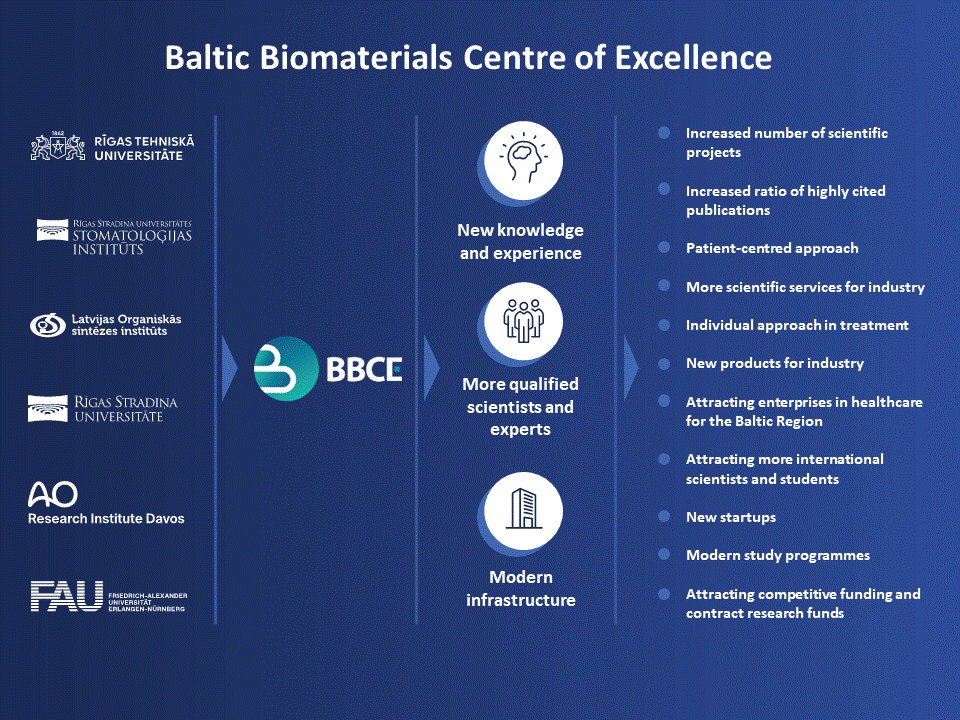
The overall objective of the BBCE is to develop a joint centre for advanced biomaterials development based on the long-term strategic cooperation between Riga Technical University, Latvian Institute of Organic Synthesis, Rīga Stradiņš University and Ltd. Rīga Stradiņš University Institute of Stomatology, on the one part, and AO Research Institute Davos, Switzerland and Friedrich-Alexander University Erlangen-Nuremberg, Germany, on the other part.